Showing posts with label spain. Show all posts

Thursday, May 2, 2013

Nevermore


The older one gets, the more one tends to succumb to that nostalgic idea of the personal golden age one presumably expiriences during the childhood. It is quite understandable how this self-deceptive image is developed in the machinery of mind - memory is selective, and as time goes by our actual memories make way for those invented by ourselves. The first, but not the only thing that makes Carlos Saura's Raise Ravens great is that it eschews the commonplace sentimentalizing on the time of joy and innocence.

Split subject: Ana looks at herself
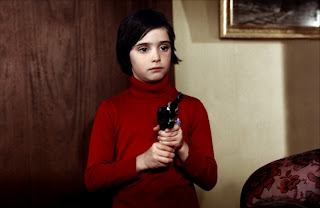
The story's protagonist is a nine year old called Ana (Ana Torrent, also known for Victor Erice's The Spirit of the Beehive and Jaime Armiñan's The Nest), and she's anything but a Little Miss Sunshine. For this sensitive girl childhood is the time of total dependence, deprivation of freedom, and fear - and is it really something special? When you're a child you must do whatever the parents tell you, anything unknown is a potential source of a danger (in terms of psychoanalisis, anything unsymbolized can cause a trauma, and there're many such things in a child's world); and everything is so bigger than you are. Saura with an assistance of Teo Escamilla (his permanent DoP) and production designer Rafael Palmero does a great job of sustaining the child's point of view throughout the film with low camera angles and elaborate organization of space - the enormous labyrinthine house where Ana and her sisters live. Ana's world is split in two, the real one and the imaginary; there is a moment of pure cinematic magic when we literally see two Anas. From the fenced garden the girl looks at the roof of a neighboring house - and sees herself jumping down.

Ana is an orphan and has to deal with loss of parents. Her mother Maria (Geraldine Chaplin, Saura's longtime collaborator and then-wife) died first - Ana saw her suffering in agony. Shortly after passed the father, and since then the three sisters has been guarded by Maria's sister Paulina. The mother and father are seen only in flashbacks and Ana's daydreams, and from these sequences we learn that Ana feels very differently about the two.

The father (Héctor Alterio) is a dominant military officer, abusive towards his wife and seemingly indifferent towards the three daughters. An embodiment of patriarchy and machismo, he is a counterpart of Luis Buñuel's male characters, typically tyrannical and obsessed with their masculinity. The father's ill-treatment of Maria leads Ana to believe that he's directly responsible for her mother's death, and to hate him. In the very first scene of the movie Ana witnesses a sexual intercourse between the father and his lover - an echo of the Freudian primal scene where a child sees his or her parents having sex and perceives this as a violent act of establishing the father's authority. The association evokes the memory of Ana's mother and the latter appears onscreen for the first time (not until the next sequence we'll learn that it's only a fantasy or hallucination). This night the father dies - poisoned by Ana as the girl herself is convinced.

The mother, on the other hand, is the parent Ana's bound to and moreover, strongly identifies with, which accounts for her hate towards the father. We see the girl pretending to breastfeed a doll, and when the sisters play house she is the mother (note how the children apply their age hierarchy to that of the family: the eldest sister plays the father while the youngest is Rosa the chambermaid). In her daydreaming Ana recalls the tender moments between the mother and herself. In one scene we see a replica of the famous shot from Bergman's Persona - Geraldine Chaplin is caressing Ana Torrent's hair in front of a mirror. Later in the movie Ana and her mother will amalgamate into one just like Persona's Liv Ulmann and Bibi Andersson - the adult Ana, who is the narrator, appears onscreen and we see that she and Maria look exactly alike.

The little heroine is afraid to share the destiny of her mother who sacrificed her career in music for the sake of her husband. Ana is resistant to every manifestation of the traumatizing male dominance - at certain point she even claims she will never wear a bra (to the elder sister's surprise); when she learns about the affair aunt Paulina has with the father's friend - who also happens to be an army man - Ana wants her guardian dead.

The fact that there're only two male characters in Raise Ravens and both of them are military officers is, of course, not a coincidence. The androcentric hierarchy of Ana's family parallels the patriarchal system of Spain under generalissimo Francisco Franco, an autocratic father figure for the whole society (like many dictators do, Franco even adopted a paternal nickname - caudillo, Spanish for chieftain). The dictator is of course represented within a film by Ana's father. The eerie funeral sequence - candlelights, silent whispering, shadowed faces - is a depiction of something Spain itself experienced two months before Raise Ravens was released, when Franco passed. Death of a fatherly dictator is always a shock, even for those who hated him - a phenomenon well-known from memoirs of people who witnessed Stalin's death in the Soviet Union. That said, it is still a relieving disposal from suppression, and Ana demonstrates her attittude by refusing to kiss the deseased; Saura does something quite similar, having overriden the ancient formula "de mortuis aut bene aut nihil." Franco/the father wouldn't have had anyone to blame but himself - it was him who raised those ravens.

Political allegory as a device of defamiliarization (and a mean to trick the censorship - although Franco's censors were not that harsh) was nothing new for Saura's work. In Raise Ravens, however, it is combined with another kind of estrangement - a  temporal distance constructed within the film. Saura had approached the theme of memory before - in El Jardín de las Delicias and La Prima Angélica - but only in the context of past events, especially the Civil War. Raise Ravens, in turn, is a memory of the present - set in the 1970s when the movie was actually made, yet designed as a rememberance. It's also the first Saura's picture to deal with a specific event contemporary to it, namely Franco's death - in fact, Saura's reaction even preceded the cause, and production began when the caudillo was still alive, though generally known to be terminally ill. Such topicality can easily lead to unnecessary present-dayness, making a film a subject to date rapidly; hence the memorial modality that allows to avoid those risks by building the narrative as it was of the events long gone (there's hope in it too - nevermore Franco will be back, he's history). One's own memories are never shocking by virtue of their nature - they're familiar to us, and our mind has a quality of coming to terms with most traumatic experiences - so instead of hysteria and agitation the intonation of Raise Ravens is calm - despite the dramatic events - and pensive. There is sadness and unchildish seroiusness in Ana Torrent's eyes, and some scenes are tantalizingly melancholic; most strikingly so is the dance to a sentimental pop hit Porque te vas.

Photography, the twentieth century's basic medium
for conservation of memory is a recurring motif in
Saura's work (see La Caza, Peppermint Frappé or
El Jardín de las Delicias for references)
So long as Raise Ravens is narrated from twenty years after, it is not a political film but a historical one. Politics doesn't know past tense - pull it out from the present, and it's not politics anymore. When things like Franco's death happen we usually say that we're witnessing the big history, which is some kind of a paradox for the history is the past and cannot be witnessed, it can only be remembered or reconstructed - or constructed for that matter. Ana herself provides an example of how the past is reinvented when she makes up a story behind an old postcard on the wall. Maybe the whole story in Raise Ravens is invented by the adult Ana - to some extent it certainly is: history is never real, it is reality symbolized, framed and edited. But here's what is interesting about this unreliable narrator: provided that she's some twenty years older than the little Ana, she must be talking from the 1990s, yet she doesn't look like she is. Instead of limiting the narrator's presence to a voice-over, which would be quite enough for comprehensibility, Saura shows us her in the flesh, dressed in fashion of the 1970s and looking exactly like Maria, the Ana's mother. Ana/Maria is seemingly not beyond the film, a part of it - and yet she is from twenty years after. She's there and she's not. So is, in turn, the film, transforming the present into past in real time. And so is cinema itself - always chasing reality only to find that, when captured, it's not real anymore.

Monday, April 22, 2013

Spain and Gain


When it comes to any sort of average, there is always a temptation of perceiving it as an allegory - especially if we are talking about an environment unfriendly towards freedom of speech like the Francoist Spain. Whether the double meaning is really intended, remains in question in case of pictures like El Extraño Viaje by Fernando Fernan-Gomez, a film noir set in a small nameless town. The story of wickedness and perversion hiding under a façade of decency could be a hint to a bigger picture of what was happening, or could be just a capture of the twentieth century's uncertainty and paranoia found not only in Spain but elsewhere. However, in case of Luis García Berlanga's ¡Bienvenido Mister Marshall! (Welcome Mister Marshall, 1952) a political message is certainly there.

How propaganda works: Villar del Río's inhabitants are
convinced of accepting the Marshall Plan in five minutes
A classical satirical comedy dealing with the theme of Spanish identity, ¡Bienvenido Mister Marshall! was created in the middle of Franco's forty years reign. The infamous caudillo's regime was officially nationalist and conservative, although by the 1950s the censorship grew relatively weak - so the overtly left directors like Berlanga and Juan Antonio Bardem got an opportunity to make their films without really being afraid of any punitive action. Bienvenido was the second of Berlanga's overall 21 films - by this time his style hadn't yet been elaborated and he hadn't yet met Rafael Azcona who would write the filmmaker's most successful oeuvre. However, as early as in his sophomore effort Berlanga ventured upon a critical comment on the very core element of the official agenda - Spanish nationalism.

Reactionary theorists tend to seek for a role model society in countryside communities, or rather in some non-exisiting idealized place called A Village. That is exactly where Berlanga heads for - an average locality of Villar del Río (literally, a village by the river): five or six streets, a plaza, a church, a cafeteria-cum-club-cum-mayor's office; bus connection to the provincial seat. Berlanga's films are known for having a choral quality, which means the frame is densely populated with characters in various social relationships with each other; these relationships are made clear through non-stop rapid dialogues. Even if there is a protagonist (which is not the case of Bienvenido), it's not an individual character that is in focus but a society. Not to be confused with an indiscrete crowd - for one thing, each member of a society has his or her own distinctive role in it, and also one of Berlanga's talents was to make all his numerous characters easily distinguishable with a couple of characteristic traits. For this type of storytelling an isolated small community like Villar del Río is a perfect setting - in some eighty minutes of running time the whole social system of the place is outlined. This average village is also a model - not a role model of what Spain should be but rather a synecdoche of the whole nation, an epitome of what it really is.

McCarthyism as imagined by a Francoist
The film starts of the reel - in five minutes or so we are introduced to the inhabitants of the village. A big event is announced by a local official - the arrival of American diplomats who enforce on the Spanish soil the so-called Marshall Plan - a program of humanitarian aid to post-WWII Europe and an early countermeasure to the increasing Soviet influence in the region (in fact, Spain never received a cent from the program). The rustic elite are at first reluctant but eventually grow enthusiastic, seduced by the transoceanic milk and honey promised to them. What begins as a light-hearted, maybe a little condescendent comedy about those loveable village folks, the salt of the Spanish earth, at some point turns out to be something quite the opposite. Behind the charming eccentricity of the village's cloth-eared alcalde, god-fearing priest and old-fashioned nobleman a dark side is revealed. The myth of the saint simplicity and purity is being destroyed little by little - you can't tell at which point the kindly irony gives way to bitterness, and the slight comic exaggeration, to a downright grotesque. (Berlanga would develop his skill of gradually turning things upside down in his later work - the most exemplary is El Verdugo (1963), a screwball comedy sliding by the end into horror, Berlanga's trademark sequence shots acquiring the suspenseful feel of an undying nightmare.)

Not only the characters disapprove the idealistic image of true Spain by their actions and attitudes, they also deliberately fake this image to please the Americans. Enter a flamenco dancer and all other aspects of Andalusian exoticism: Villar del Río is transformed into a phoney southern village. Rundown houses are camouflaged under fake white walls and openwork ivied balconies, the villagers put on folk costumes and take guitars in their arms. The village is, in fact, by no means Andalusian - it's situated someplace in the central region of Castilia - but who cares anyway? Spain-ness thus is a construct - formed in many respects from the outside, as the villagers employ external stereotypes about Spain.

Yet another great performance by El Verdugo's José Isbert
Nationalism also leads to isolation and subsequently to ignorance, and the residents of Villar del Río are as prejudiced about American culture as Americans presumably are about their own. The night before Mister Marshall arrives four leading characters are dreaming. This is the climax of Bienvenido, as its grotesque reaches the highest point here. Alcalde's dream, for instance, is a parody of Western genre movies with all Bienvenido's characters dressed as cowboys and speaking gibberish English. Meanwhile the cowardly padre who knows that most Americans are Protestant is having a nightmare about being captured by KKK and interrogated by the House Un-American Activities Committee. What the poor fellow does not know is that HUAC and Marshall Plan he waits for so desperately are two links of the very same anti-communist chain. Political right knows few national differences.